

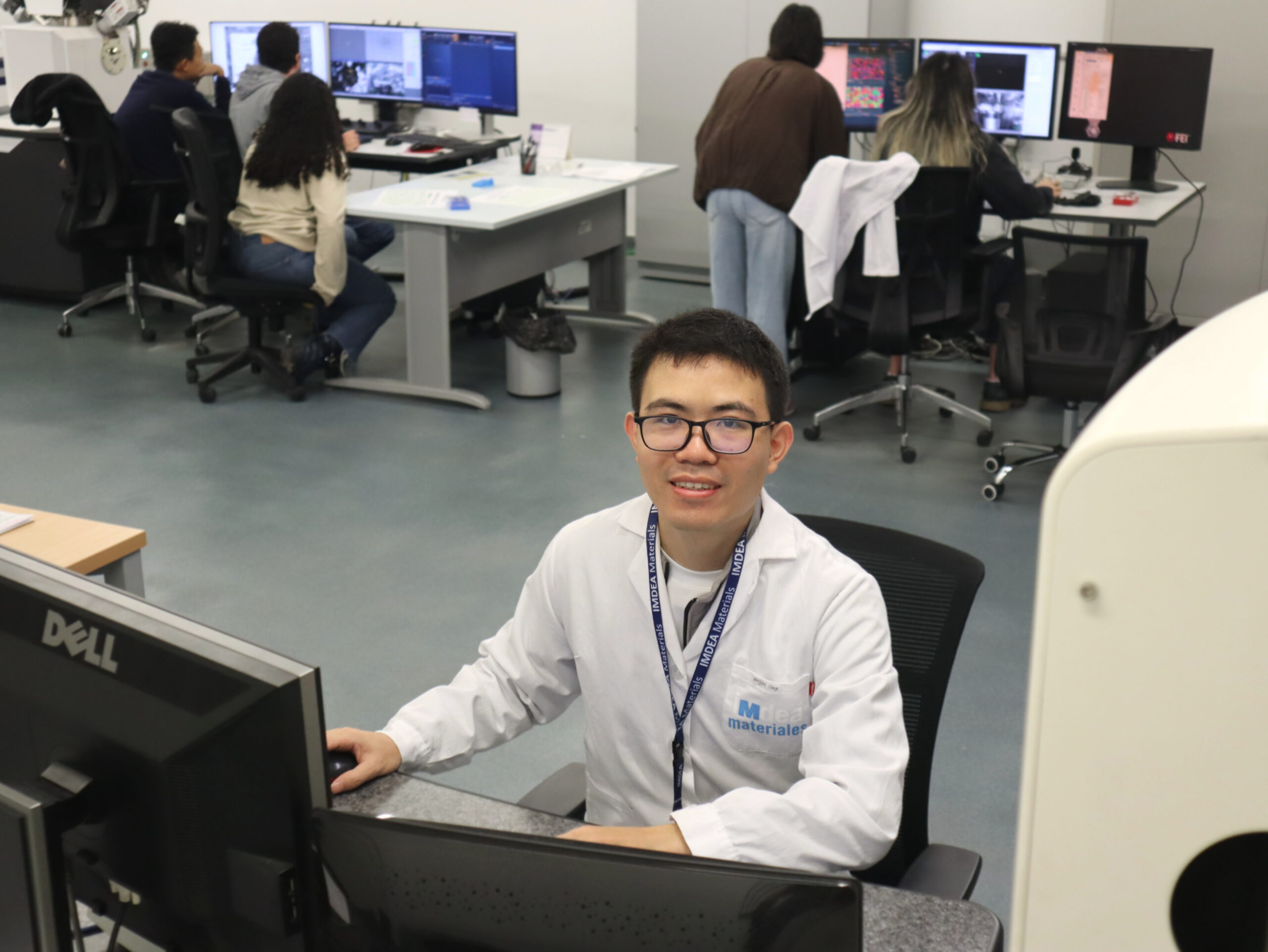
As part of the ATENEA programme, outstanding international researchers are joining IMDEA Materials Institute to advance cutting-edge scientific projects and strengthen international collaboration. One of these fellows is Dr. Xiangkai Zhang, who is carrying out the project GB-MPEAs.
With more than a decade of experience in metallic materials research, Dr. Zhang’s work focuses on understanding how the microscopic structure of advanced alloys influences their mechanical performance. His ATENEA project explores the role of grain boundaries in multi-principal element alloys (MPEAs), with the aim of improving the reliability and predictability of materials designed for demanding applications.
Can you please give a brief personal background of your research/academic/industrial career to date?
I am a materials scientist with over ten years of experience investigating how the microstructure of metallic alloys influences their mechanical properties. I earned my PhD from City University of Hong Kong and subsequently worked there as a postdoctoral researcher. I have also served as an Assistant Professor at Fuzhou University, China. My research combines advanced microscopy, including in-situ electron backscatter diffraction and transmission electron microscopy, with molecular dynamics simulations, focusing particularly on multi-principal element alloys (MPEAs).
Can you please explain how you came to form part of the ATENEA project? What was your motivation for taking on this opportunity?
I applied to the ATENEA programme with a research proposal focusing on the role of grain boundaries in MPEAs. Following a rigorous selection process involving evaluation by international experts and an interview, I was delighted to be selected as one of ten fellows.
I was particularly motivated by the outstanding reputation of IMDEA Materials Institute and its expertise in combining advanced experimental techniques with computational modelling.
ATENEA also provides me with valuable opportunities to acquire new research skills, work with internationally renowned scientists, and establish long-term international collaborations, supporting my future development as an independent researcher.
Can you please give a brief overview of the key objectives of your project?
My project, GB-MPEAs, investigates how grain boundaries influence plastic deformation and strength in MPEAs. A central question is whether dislocations can pass through these boundaries or become blocked, as these interactions play a crucial role in determining mechanical performance.
The project has three main objectives. First, we aim to establish reliable geometrical criteria for predicting dislocation slip transfer or blocking across grain boundaries. Second, we investigate the underlying interaction mechanisms using advanced microscopy and mechanical testing. Third, we incorporate these findings into crystal plasticity models to predict how grain size affects alloy strength.
By combining experimental observations with computational modelling, we aim to connect microscopic deformation mechanisms with macroscopic mechanical properties, providing a scientific basis for more reliable predictions of alloy performance.
Why is this project important for society?
When we board an aircraft or rely on a power plant, we rarely think about the metals that make these systems safe and reliable. Yet these materials must withstand demanding conditions for years without failing unexpectedly.
MPEAs offer exciting possibilities, but their mechanical performance depends strongly on how dislocations interact with grain boundaries. These interactions can strengthen alloys by hindering dislocation motion or facilitate coordinated deformation by allowing dislocations to pass into neighbouring grains. However, dislocation blocking can also lead to local stress concentrations and potentially initiate damage.
Understanding these competing effects is therefore essential for developing materials that combine high strength, ductility, and reliability.
My project aims to bridge this knowledge gap and provide a scientific basis for more reliable predictions of alloy performance. In the long term, this could help engineers develop safer, longer-lasting components for aerospace and energy applications, reducing maintenance costs, improving resource efficiency, and supporting more sustainable technologies.
ATENEA Fellow Profile
Name: Dr. Xiangkai Zhang
Project: GB-MPEAs
Fellowship period: 1 November 2026 – 30 April 2029
Research area: Metallic materials, microstructure-property relationships, multi-principal element alloys (MPEAs), advanced microscopy and computational modelling.
About ATENEA
ATENEA is an international fellowship programme co-funded by the European Union through the Marie Skłodowska-Curie Actions (MSCA) COFUND initiative. The programme supports excellent researchers from around the world, enabling them to develop ambitious research projects while strengthening Madrid’s position as a leading centre for scientific excellence and innovation.
Through projects such as GB-MPEAs, ATENEA fellows are helping to generate new knowledge and technologies that will contribute to safer, more efficient and more sustainable solutions for the future.