

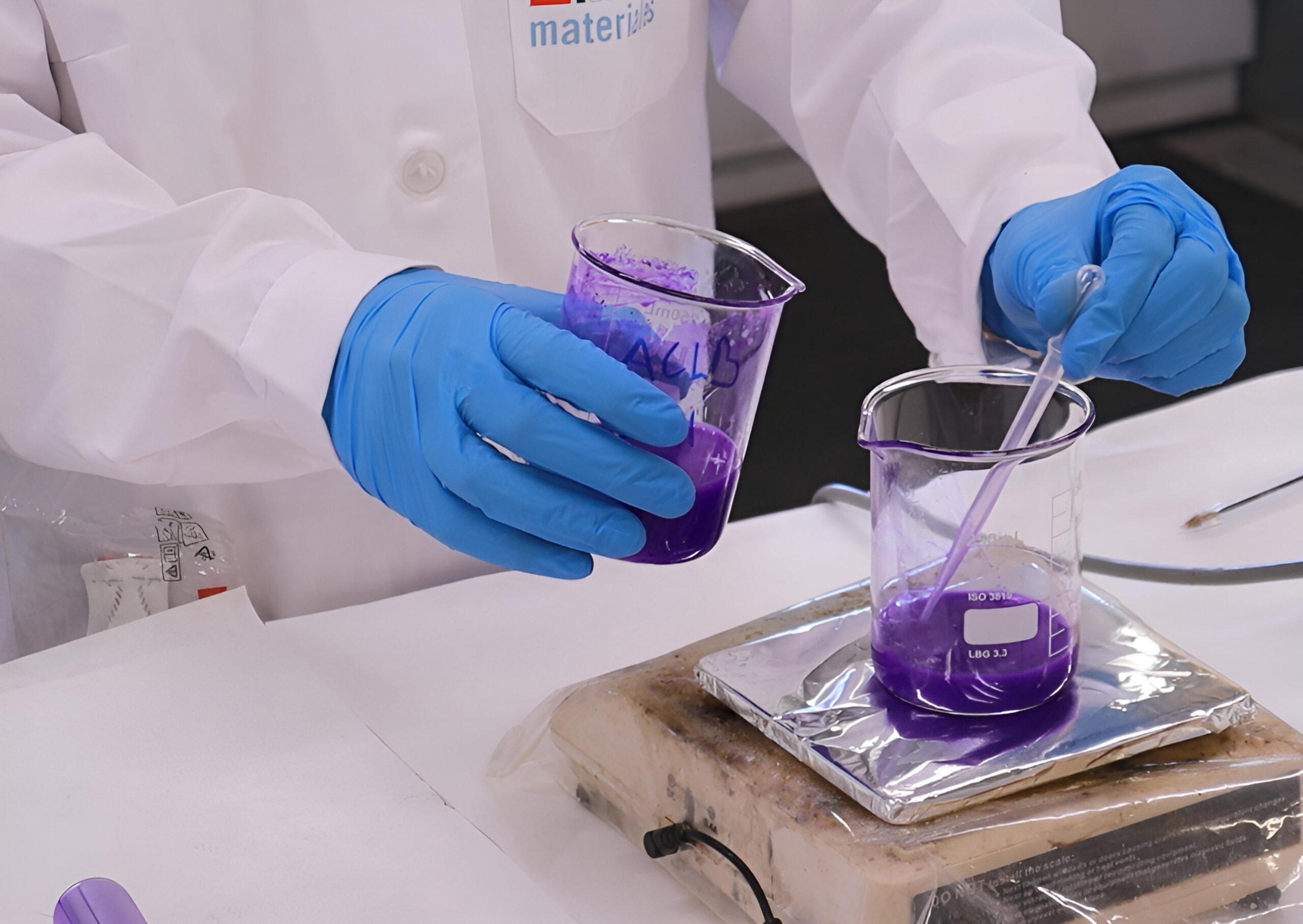
Researchers at IMDEA Materials Institute aim to transform recycled cobalt from lithium-ion batteries into advanced fire-safe materials for next-generation energy storage.
IMDEA Materials is pleased to announce the start of a new research project under the recently launched ATENEA Programme, welcoming researcher Dr. Anna-Caroline Lavergne Bril to the Institute.
The project will explore innovative approaches to the circular use of critical raw materials by developing new methods to recover and repurpose cobalt from end-of-life lithium-ion batteries. By combining materials synthesis, battery technology and computational modelling, the research seeks to improve both the sustainability and safety of future energy storage systems.
As demand for electric vehicles and renewable energy storage continues to grow, securing access to critical battery materials has become a major challenge. Cobalt helps some lithium-ion battery cathodes store and release energy while keeping their structure stable during repeated charging and discharging.
However, cobalt is also classified by the EU as a critical raw material, and its extraction is energy-intensive and dependent on global supply chains.
“Even if you recover many of the materials inside a battery, cobalt remains especially important because of the amount of energy required to produce it in the first place,” explains Dr. Lavergne Bril. “Finding ways to recover and reuse this material is essential if we want battery technologies to become truly sustainable.”
Unlike conventional recycling approaches that seek to recover cobalt for reuse in battery cathodes, the new project will investigate a novel route. Dr. Lavergne Bril’s research efforts will focus on instead transforming recycled cobalt into a new material with fire-retardant properties that can be incorporated into battery separators.
The resulting material could contribute to improving battery safety while creating additional value from end-of-life batteries.
The research will initially focus on demonstrating the concept under laboratory conditions before progressing towards validation using real battery recycling streams through an international secondment.
The project brings together several areas of expertise available at IMDEA Materials, including battery technologies, fire-safe materials and advanced computational modelling.
Researchers will investigate not only how to synthesise the new cobalt-containing materials but also the mechanisms behind their formation and performance. Computational simulations will help optimise the process and identify new pathways for designing advanced recycled materials.
The research addresses broader European challenges related to resource security and the circular economy. As Europe seeks to reduce its dependence on imported critical raw materials, end-of-life products are increasingly being viewed as valuable sources of strategic resources, often referred to as “urban mines“.
Lithium-ion batteries contain materials that are difficult and costly to obtain through conventional mining. Developing new technologies to recover and exploit these resources could help strengthen Europe’s technological sovereignty while reducing waste.
“Future sources of critical materials will increasingly come from the products we have already used,” Dr. Lavergne Bril adds. “Waste contains significant value, and we need innovative ways to recover and reuse these resources.”
The project forms part of ATENEA, a Marie Sklodowska Curie Actions (MSCA) postdoctoral fellowship programme, which aims to attract outstanding international researchers to conduct pioneering research in Madrid’s scientific ecosystem.
Having previously worked at the French Alternative Energies and Atomic Energy Commission (CEA) and the University of Grenoble, Dr. Lavergne Bril was drawn to IMDEA Materials by its international environment and its multidisciplinary research culture.
“I had already heard of the IMDEA Institutes and was attracted by their strong reputation in their respective fields,” she says. “The opportunity to work in such an international research environment, while also benefiting from the quality of life that Madrid offers, made IMDEA Materials a particularly appealing destination.”